Coreless Thermal Receipt Paper Roll
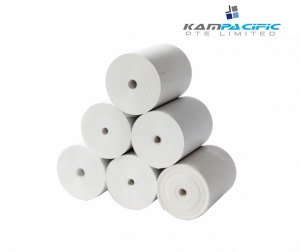
Description:
- Convenient and time saving when replacing with new a roll
- Cost-saving as has no difference from those with core
- Save storage space
- Less dust
- Environmental friendly as there is not core to dispose
Get a Quote
TIME SAVING & CONVENIENT – Since the entire thermal roll is fully utilized, user can easily replace new roll into the printer without having the need to remove the core before affixing the new roll, hence saving precious time and enhancing the casher’s productivity especially during peak hours.
LONGER PAPER LENGTH – By eliminating the core, with this saved space, more paper can be wrapped for the roll, thereby reducing the thermal roll reload frequency. Further, the user benefits from being able to use every inch of the product they pay for instead of paying for a paper / plastic / honeycomb core that will be discarded and of no economical value. Imagine saving that money and converting it into buying more paper rolls! Moreover, coreless rolls are cheaper in price compared to cored rolls because of the expense of making the core.
SAVE TRANSPORTATION COST – Since coreless thermal rolls do not have a core in the middle, the rolls have smaller diameter, which translate into more rolls being able to be fitted into the carton box, hence lower transportation cost per roll.
SAVE STORAGE COST – With a shrinking diameter, the coreless thermal roll takes up lesser space in comparison to a standard cored roll of the same length, thus saving storage space, and is especially useful where the user has limited storage space.
LESS DUST – Paper core will create and accumulate dust in the printer’s print-head. User has to clean the print- head regularly to remove the dust. This is because an accumulation of dirt, dust, or other contaminants on a print head can result in poor quality, unreadable printouts. With coreless thermal roll, less dust is accumulated in the print-head thereby prolonging the print-head’s lifespan.
ENVIRONMENTAL FRIENDLY – Opting for coreless thermal rolls will positively impact the environment, since the traditional cores are not always properly recycled and usually end up in the landfill. By going coreless, the need to dispose off the core is dispensed with, thereby environmental friendly. After all, according to United Nation Environment, “If you can’t reuse it, refuse it”.